Every May, I watch the same small drama unfold in my garden. The peony buds swell like green golf balls, then crack open in a single warm weekend, and I’m standing there with a coffee thinking: this is the best week of the year. Then a thunderstorm rolls through, and ten days later the petals are scattered across the mulch. If you’ve ever felt cheated by how fast peonies come and go, you’re not imagining it. The show really is short. But there are good biological reasons for that, and a surprising number of ways to stretch it out.
What’s happening inside a peony flower
A peony bloom is a big investment. Each flower can hold dozens of petals, and the plant builds them from energy stored in thick tuberous roots. Those roots are a savings account. The plant spends it in a quick burst in late spring, and the main goal is not to look pretty for us. It’s to attract pollinators and set seed.
Once a flower has been open for a few days and pollen has been shed, the plant has little reason to keep the petals. Ethylene, a plant hormone, rises as the flower ages, and the petals begin to drop. Heat speeds this up. Warm temperatures raise a plant’s metabolic rate, so everything runs faster: opening, aging, shattering.
Most garden peonies (Paeonia lactiflora, the classic herbaceous type) bloom for roughly 7 to 10 days per flower. A whole plant might stay in color for 10 to 14 days, depending on the weather. Double forms like ‘Sarah Bernhardt’ are especially vulnerable, because their heavy heads soak up rain and bend to the ground.
Weather: the biggest wild card
In most of the U.S., peonies bloom between late April in the South and late June in northern states and the Mountain West. They need winter chilling (generally 500 to 1,000 hours below 40°F), which is why they struggle in USDA zones 8 and above and thrive in zones 3 to 7.
Here’s the catch. A sudden 85°F day in the middle of bloom can cut the display in half. Heavy rain, wind, and late frosts do similar damage. You can’t control the sky, but you can soften its effects:
- Plant in a spot with afternoon shade. Full sun is still best for flowering, but a site that gets relief after 3 p.m. keeps petals fresher in hot spells.
- Shelter from wind. A fence, hedge, or the east side of a building makes a real difference.
- Stake early. Put grow-through hoops or peony rings in place when shoots are about 6 inches tall. Trying to add support once buds are heavy usually means broken stems.
- Cover during storms. An old bedsheet or a floating row cover, draped lightly over stakes the evening before a hard rain, can save a bloom week.
Plant a longer season, not just a longer bloom
This is the trick I wish I’d learned earlier. Peonies come in different bloom-time groups, and mixing them can stretch your season from two weeks to six.
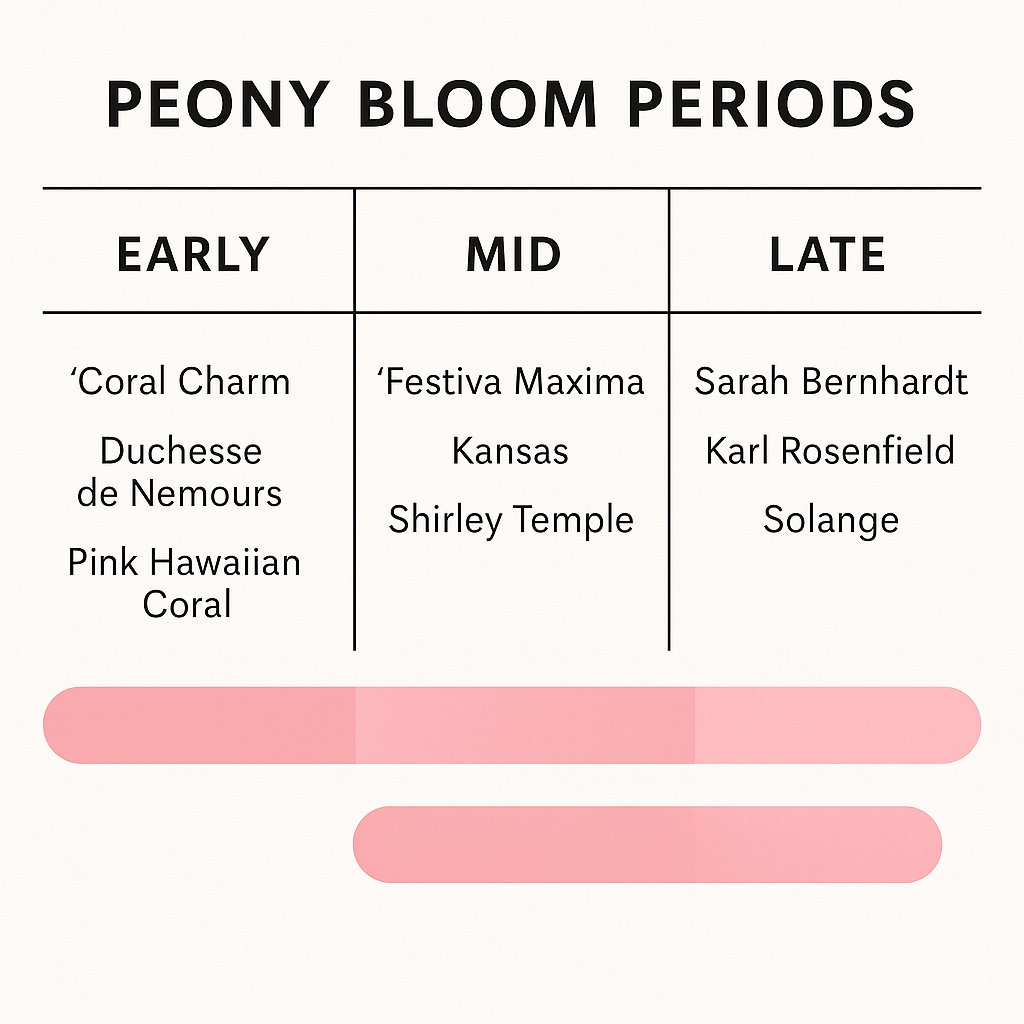
Early, mid, and late varieties
- Early: Fernleaf peony (P. tenuifolia), ‘Red Charm’ and many hybrid types, usually opening 1 to 2 weeks before the classics.
- Mid-season: ‘Sarah Bernhardt’, ‘Festiva Maxima’, ‘Karl Rosenfield’. These make up most of what you see in neighborhood gardens.
- Late: ‘Bowl of Beauty’ and ‘Duchesse de Nemours’ often come 1 to 2 weeks after mid-season.
Don’t skip the other peony types
Itoh (intersectional) peonies, such as ‘Bartzella’, bloom after the herbaceous ones and can produce 50 or more flowers on a mature plant over several weeks. Tree peonies (P. suffruticosa) open earlier, often in late April or May, on woody stems. Combine all three groups and you can have peonies for a month and a half in many climates.
Make cut flowers last, too
Cutting is the most underrated way to enjoy peonies longer. Flowers in a vase are protected from rain and heat, and they keep opening indoors for days.
The “marshmallow stage”
Cut buds when they feel soft like a marshmallow when gently squeezed, and show a little color. Hard, tight buds (“golf balls”) may never open. Fully open flowers have only a few days left.
Steps for a vase that lasts
- Cut in the cool of early morning, leaving at least two sets of leaves on the plant so it can keep feeding its roots.
- Strip most of the foliage from the stems and recut at an angle.
- Place in lukewarm water with a little flower food.
- Keep the vase away from fruit bowls (ripening fruit gives off ethylene) and direct sun.
- Change the water every two days and recut an inch off the stems.
Want blooms later? Cut buds at the marshmallow stage, wrap them dry in paper, lay them in a box, and store in a refrigerator for up to three weeks. Florists do this all the time to extend peony season well into summer. Just be sure the fridge is cold (around 34 to 36°F) and free of fruit.
Care that pays off next spring
The bloom you get this year depends partly on how you treated the plant last year. A few habits help:
- Plant crowns with the pink “eyes” only 1 to 2 inches below the soil surface. Planting too deep is the classic reason for leafy plants with no flowers.
- Skip heavy nitrogen fertilizer. A light dose of bone meal or a balanced, low-nitrogen feed in early spring is enough.
- Leave the foliage alone after flowering until it yellows in fall. The leaves recharge the roots.
- Be patient. A new division can take three years to bloom well, but peonies can live for decades.
A short season is part of the charm
Peonies will never bloom like zinnias, which keep going until frost. Their brief, extravagant moment is built into their biology. But with a little planning – a mix of early and late varieties, some support and shelter, and a few buds cut for the kitchen table – you can easily turn two weeks into six. Next spring, try noting in a garden journal which plants opened when. After a year or two, you’ll have your own bloom calendar, and that’s the best guide for deciding what to add next.