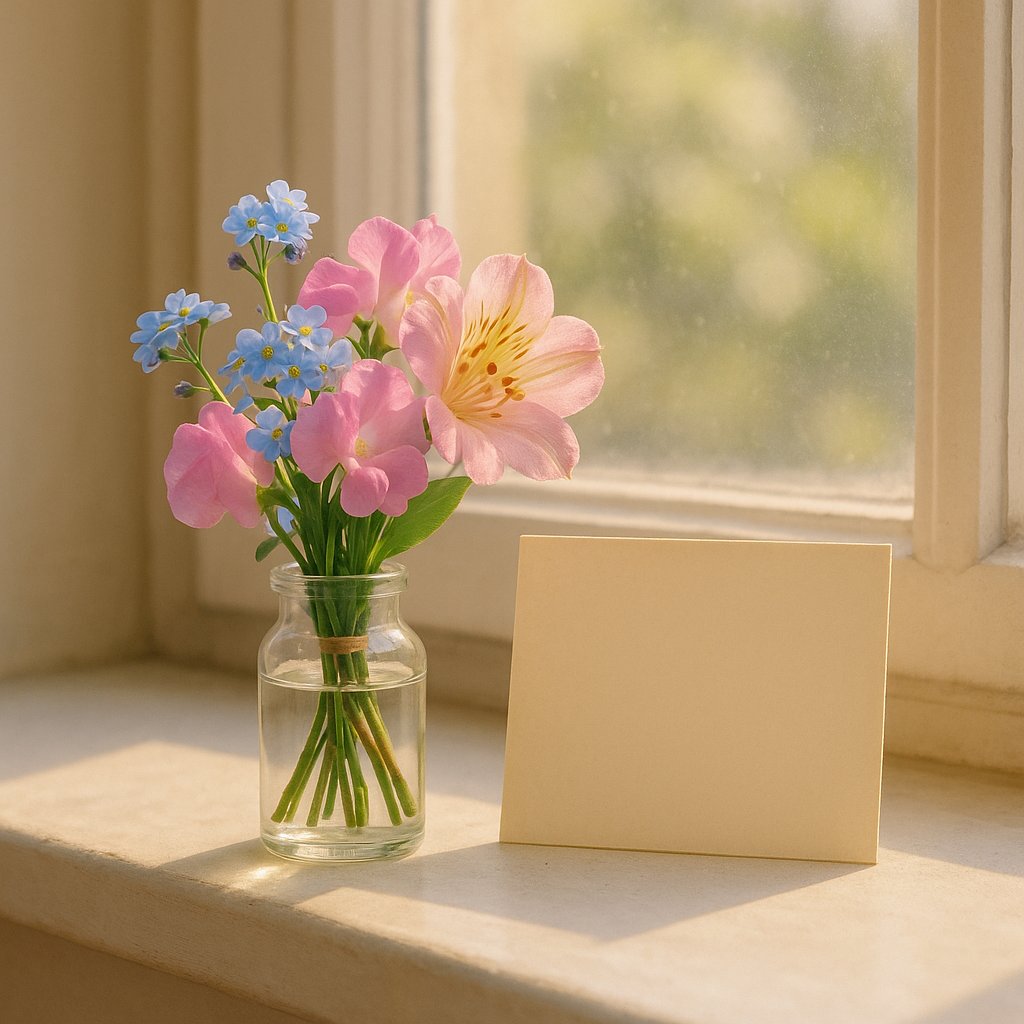
My friend Hannah spent eleven months in Singapore while her partner stayed in Leeds. A seven-hour time difference meant most of their conversations happened at odd hours, half-asleep. What she remembers most isn’t the calls, though. It’s the small bunch of sweet peas that turned up on her windowsill one Tuesday, with a card saying only “Smells like home.”
Flowers can’t close the distance, but they can do something texts and emojis struggle with. They take up physical space in the other person’s day, and they change the room. Here’s how to make them say “I miss you” clearly and thoughtfully, rather than just “I remembered.”
Why flowers work when words start to feel thin
Couples who live apart tend to describe the same problem. The conversation becomes logistics: schedules, flight prices, “how was your day?” on repeat. A bouquet breaks that pattern. It’s unexpected, it’s tangible, and it gives the recipient something to look at, smell and tend to.
There’s also the slow-burn effect. A message is read and gone in seconds, but a bunch of flowers lasts a week or two. Every time your partner walks past, there’s a small reminder that somebody thought about them in a particular moment.
Choosing flowers that actually carry the message
You don’t need to memorise Victorian floriography, and meanings vary between sources anyway. Still, a few flowers have associations that are widely recognised and pair well with “I miss you.”
- Forget-me-nots – the name does the work. Lovely in a small posy, especially in spring.
- Sweet peas – traditionally linked to fond farewells and “thank you for a lovely time.” Scented and seasonal, usually May to August in the UK.
- Peonies – romance and affection, but short-lived in season (roughly late spring to early summer).
- Tulips – often read as declarations of deep love, and a good-value choice from winter into spring.
- Alstroemeria – associated with devotion and lasting bonds, and one of the longest-lasting cut flowers.
- Lavender – devotion and calm. Useful for partners who are stressed or sleeping badly.
Think about longevity, not just looks
This is the mistake I see most. A gorgeous but delicate bouquet that spends two days in transit can arrive looking tired. If there’s any travel involved, sturdier stems give you a better margin: alstroemeria, carnations, chrysanthemums, lisianthus and roses usually last 7–14 days with decent care. Delicate blooms like poppies or sweet peas are lovely, but they’re better for short, local journeys.
Consider the person, not just the symbolism
A heavily scented lily bunch is wonderful for some and a migraine trigger for others. Lilies are also toxic to cats, which matters if your partner has one. Ask a mutual friend, or think back: which colours do they wear, what’s on their kitchen table, what did they say about their grandmother’s garden? A personal detail beats a textbook meaning every time.
Sending across borders: what to know first
When you’re in different countries, logistics matter as much as the flowers. If the two of you are separated by a border, it helps to understand how international flower delivery usually works. Many services pass the order to a local florist in the recipient’s country rather than flying stems across the world. That tends to mean fresher flowers, but the exact varieties may differ slightly from the photo, so check the substitution policy.
A few practical points are worth checking before you order:
- Time zones. Work out what time the flowers are likely to arrive, and whether someone will be home to receive them.
- Local holidays. Valentine’s Day, Mother’s Day and other occasions fall on different dates in different countries, and busy periods can affect availability.
- Address details. Include a phone number and any building-access notes. Missed deliveries are the most common cause of disappointment.
- Import rules. Plant health rules apply to some cross-border shipments, particularly live plants. Cut flowers sent through a local florist are generally simpler, but it’s worth asking.
Making the moment land: the card and the timing
The card is where “I miss you” becomes specific. Generic lines like “Thinking of you” are fine, but a detail is better: “Missing our Sunday walks on the Heath.” Two sentences are plenty. If you’re worried about sounding soppy, remember that nobody has ever complained about feeling missed.
Timing is a quieter skill. Flowers on a birthday are expected. Flowers on a grey Wednesday, or the day before a tough presentation, are a surprise. Some couples I know also arrange a video call for when the flowers arrive, so the recipient opens the package while the sender is on screen. It turns a delivery into a shared moment.
Keeping the gesture going
One bouquet is lovely. A small ritual is better. Some people send something simple on the first of each month, or mark each “halfway” point before a visit. Others pick one flower that becomes “theirs” and use it again and again. Over time, that flower becomes a private language.
A small gesture with a long reach
Distance makes affection harder to show, so the thoughtful details matter more. Choose flowers with meaning and staying power, think about the person receiving them, check the practical details, and write a card that sounds like you. If you’d like to go further, look into how seasonal availability and local florist networks differ between countries. A little research can make the next bunch even more personal.