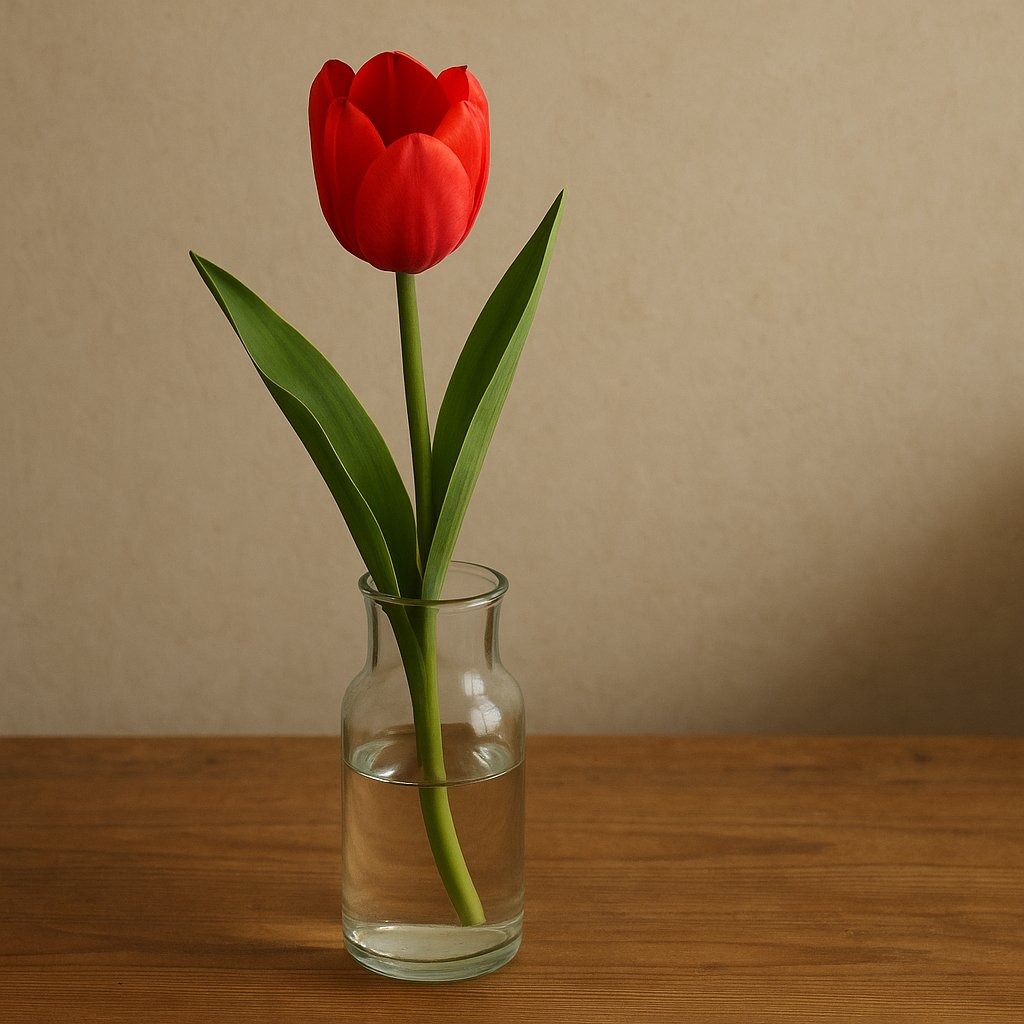
Picture a small paper-wrapped bouquet with exactly one red tulip in it. No baby’s breath, no ribbon, no card. Just a single cup-shaped bloom on a green stem. Is it a confession, a thank-you, or a florist’s shortcut? The answer depends on history, timing, and the people involved. I’ve watched friends argue over this exact question, so it deserves a proper look.
Where the red tulip got its romantic reputation
Tulips did not start out as American sweethearts. They came from Central Asia and were cultivated by the Ottomans, who prized them as symbols of abundance and divine beauty. Dutch growers later made them famous in Europe, and the 1630s “tulip mania” turned bulbs into status objects.
The romantic link is older than many people realize. A popular Persian and Turkish legend tells of Farhad, a heartbroken lover who, hearing false news that his beloved Shirin had died, rode his horse off a cliff. Red tulips are said to have sprouted where his blood fell. Literary scholars debate how much of this is folklore, but the story stuck: the red tulip stands for deep, almost consuming love.
In Victorian floriography, the “language of flowers,” a red tulip was commonly read as a declaration of love. Dictionaries of the era varied, so treat it as a tradition rather than a strict code.
What one red tulip says today
A single stem tends to be quieter than a dozen roses. That is exactly its strength. Here are the most common readings in modern American relationships:
- “I love you,” said gently. Early in dating, a lone red tulip can be a low-pressure way to show real feeling without the drama of a grand gesture.
- “I’m thinking of you.” Between long-term partners, one tulip on a desk or kitchen counter reads as affection, not obligation.
- “I’m sorry, and I mean it.” After an argument, one flower can feel more sincere than an oversized bouquet that looks like a bribe.
- “You’re my one.” The number one carries its own meaning. One flower suggests singular focus on a single person.
In my experience, the gesture lands best when it is tied to something personal. A tulip handed over with “these reminded me of your grandmother’s garden” says far more than the flower alone.
Context changes the message
Flowers never speak in a vacuum. The same red tulip can mean different things depending on the moment.
Stage of the relationship
On a second or third date, a single tulip signals interest and taste. Some people may read it as cautious, which is fine. In a marriage of twenty years, it can be a reminder that romance didn’t retire. Surprise matters more than size.
Season and freshness
Tulips are a spring flower, with peak availability in the U.S. from roughly March through May, and Washington State’s Skagit Valley and Holland, Michigan, host well-known tulip festivals. Giving one in February is a small flex: it suggests effort. Giving one in April feels natural and seasonal, like a little piece of spring.
Red versus other colors
| Color | Common meaning |
|---|---|
| Red | Passion, declared love, devotion |
| Pink | Affection, care, gentle admiration |
| Yellow | Cheerfulness, friendship (older “hopeless love” readings are mostly outdated) |
| White | Forgiveness, respect, new beginnings |
| Purple | Admiration, elegance |
How to give one so it means something
- Choose a stem that’s just opening. Tulips keep growing after they’re cut, so a bloom that’s slightly closed will look best for several days.
- Keep the presentation simple. Plain kraft paper or a slim bud vase lets the flower do the talking.
- Add a short, specific note. One sentence beats a paragraph. “Because you noticed I was tired” is better than “Happy Tuesday.”
- Mind the water. Trim the stem, use cool water, and keep it away from ripe fruit and direct heat. Tulips are sensitive to ethylene gas from fruit.
- Don’t use it as a substitute for conversation. A flower can open a door, but it can’t replace an honest talk after a real conflict.
When a single tulip might miss the mark
A few honest caveats. Some people simply prefer roses, and a lone tulip may seem minimal if they expect tradition on Valentine’s Day. Others might not know the symbolism at all and read it as “just a flower.” That isn’t a failure. If the meaning matters to you, say it out loud. Also, if you’re apologizing for something serious, one tulip alone won’t carry the weight.
The quiet power of one
A single red tulip works because it is deliberate. It carries centuries of legend, a clear color code, and the simple message that you chose this one thing for this one person. Pair it with a real sentence, a good moment, and a little attention, and it can say what a large bouquet sometimes can’t.
If this sparked your curiosity, try reading about Victorian floriography or the Persian story of Farhad and Shirin. You’ll find that nearly every flower on a grocery store shelf has a story worth knowing.