A few springs ago, I watched a woman kneel at the edge of a cemetery path in Oregon and press a pinch of tiny blue seeds into the soil near a headstone. She didn’t say much. She just patted the dirt, sat back, and smiled. “He hated lilies,” she told me. “These he would have tolerated.” That small, funny, tender moment says a lot about forget-me-nots. They are modest flowers that carry a heavy message.
Here is what this little blue bloom has meant to people in love, in grief and in remembrance, and why it still shows up in gardens, funerals and keepsakes in 2026.
Where the name came from
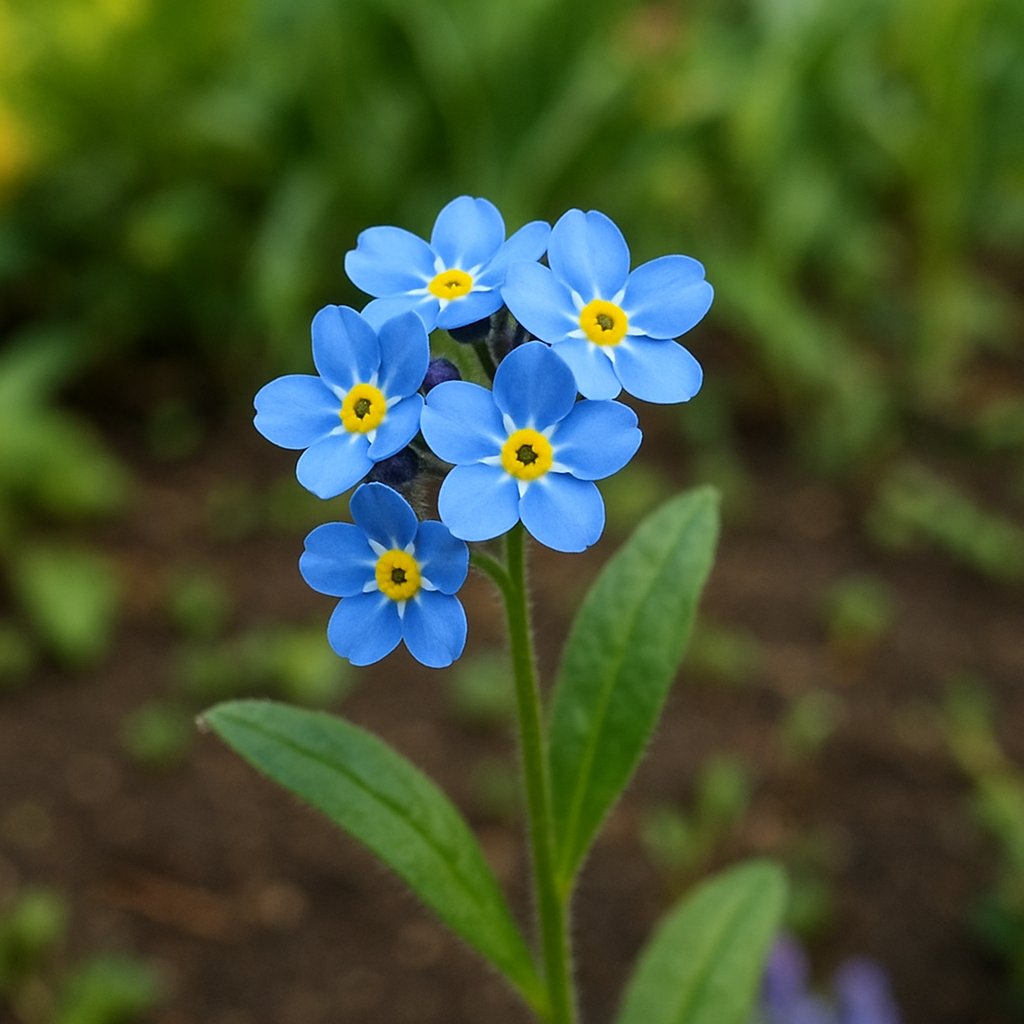
The plant is Myosotis, from the Greek for “mouse’s ear,” a nod to its soft, small leaves. The English name is much more romantic, and it echoes older European names. The German Vergissmeinnicht, the French ne m’oubliez pas and the Dutch vergeet-mij-nietje all say the same thing: do not forget me.
The best-known legend is a German one. A knight and his lady were walking by a river when he leaned down to pick a cluster of blue flowers for her. His armor pulled him into the current. As he went under, he threw the bouquet to her and cried, “Forget me not!” It’s almost certainly folklore, but it explains why the flower became tied to devotion and to loss at the same time.
Forget-me-nots as a symbol of love
In medieval and Victorian Europe, these flowers were a quiet promise. Blue was associated with loyalty and constancy, and the flower’s small size suited private gestures. Lovers exchanged them as tokens of faithfulness, especially when they were about to be separated by war, travel or family disapproval.
Victorian “floriography,” the so-called language of flowers, made this official. A bunch of forget-me-nots meant true love and remember me. Some sources add nuance, saying it could also mean “I will be faithful even when we’re apart.” It worked as a message you could hand over without saying a word.
The romantic meaning hasn’t vanished. I still see forget-me-nots tucked into wedding bouquets, printed on invitations and stitched into handkerchiefs. Brides sometimes carry them as a “something blue” that honors a relative who can’t be there, which blends love and memory neatly.
Why they became a flower of grief
The shift from romance to mourning was natural. If “remember me” is a promise between living people, it becomes something deeper when one of them is gone. The message turns around: we will remember you.
A few reasons explain why this flower fits grief so well:
- It returns. Forget-me-nots self-seed generously. A patch planted once can reappear every spring for years, which feels like memory that renews itself.
- It is unshowy. Grief is rarely loud. A drift of small blue flowers feels gentler than a formal arrangement.
- It blooms in spring. Flowering from roughly April to June in much of the US, it arrives just as the ground wakes up, pairing loss with continuity.
- The color is calming. Blue is often linked with peace, sky and water, all common images in condolence traditions.
Many people plant them on graves or in memorial beds for exactly this reason. They don’t demand much care, and they tend to spread in a soft, natural way.
Remembrance in the wider world
The flower has also taken on public meanings well beyond personal mourning.
Alzheimer’s awareness
In the United States and elsewhere, the forget-me-not is widely used as a symbol for Alzheimer’s and dementia awareness. The link is poignant: the flower’s name is about not being forgotten, which is a fear for both people living with memory loss and the families who care for them. You will often see small blue pins or flower logos during awareness campaigns in autumn and on dementia-related walks.
Historical remembrance
In Germany, the flower was used as a badge of remembrance after World War I and in later decades. In Newfoundland, Canada, a forget-me-not emblem is worn in early July to honor those lost in the Battle of the Somme, where the Royal Newfoundland Regiment suffered devastating casualties. Alaska also chose the forget-me-not as its state flower in 1917, reportedly after a schoolboy’s design proposal and a territorial vote. Its small, hardy nature suited a place known for endurance.
Infant and pregnancy loss
Among bereaved parents, forget-me-nots often appear in memorial jewelry, remembrance gardens and hospital memory boxes. For families who have lost a baby, the flower offers a simple way to say a child existed and is still loved, even when others avoid the subject.
Practical ways to use forget-me-nots as a tribute
If you would like to honor someone with these flowers, you have more options than a bouquet. Here are a few that I’ve seen work well:
- Plant a small memorial patch. Scatter seeds in early spring or late summer in partial shade with moist soil. They thrive near ponds, under trees and along shady borders.
- Press a few blooms. Dried between heavy book pages, they hold their color surprisingly well. Frame them or slip them into a card or journal.
- Include them in a funeral or memorial arrangement. Even a few stems among white roses or ferns can give the piece a personal touch.
- Give a seed packet at a service. This is a quiet, lasting keepsake, and guests can plant them at home.
- Mark an anniversary. Some families bring a small pot of forget-me-nots to a grave on a birthday or death date each year.
One practical note: forget-me-nots can spread aggressively in some regions, and certain species are considered invasive in parts of the US. Check your state or local extension service before planting near natural areas, and choose native Myosotis species where they are recommended.
A small flower with a big job
Forget-me-nots mean remember me in love, we remember you in grief, and let’s not let this be lost in public remembrance. The meaning shifts with the moment, but the core stays the same: people matter, and memory is a form of care.
If this flower speaks to you, try reading about the Victorian language of flowers or the history of memorial gardens. You may find other quiet symbols that help you say what words sometimes can’t.