Imagine a single rye plant. Nothing special – just an ordinary grass growing in a pot of soil. In 1937, botanist Howard Dittmer carefully washed the roots of one such plant and counted them. The total? Roughly 14 billion root hairs, stretching across a combined length of over 6,000 miles. That’s enough to reach from New York to Tokyo and back.
We spend so much time admiring what grows above ground – the flowers, the fruit, the towering canopy – that we forget the real engine of plant life is working in total darkness, right beneath our feet. Roots don’t just anchor a plant. They negotiate, communicate, fight, and form alliances in ways that would rival any political drama.
Here’s what’s actually going on down there.
More than an anchor – how roots navigate their world
Most of us learned in school that roots grow downward because of gravity. That’s true, but it barely scratches the surface. Root tips contain specialized cells called statocytes that function like tiny gyroscopes, sensing gravitational pull and directing growth accordingly. But gravity is just one signal in an overwhelming flood of information.
Roots can detect moisture gradients and grow toward water sources – a behavior called hydrotropism. They sense patches of nutrient-rich soil and proliferate root hairs in those zones while essentially ignoring barren areas. They even respond to touch. When a root tip encounters a rock or compacted clay, it redirects itself around the obstacle, sometimes within hours.
What surprised researchers most in recent decades is that roots appear to “choose” their path. A 2012 study published in PLOS ONE showed that corn roots can distinguish between a nutrient-rich patch and an inert object of the same density. They don’t just blunder forward – they evaluate.

The rhizosphere – a bustling metropolis you can’t see
The rhizosphere is the narrow zone of soil immediately surrounding a root, and it might be the most ecologically dense habitat on the planet. In a single teaspoon of healthy rhizosphere soil, you can find more microorganisms than there are people on Earth – bacteria, fungi, protozoa, nematodes, and archaea all jostling for position.
But this isn’t chaos. It’s commerce.
The carbon-for-nutrients trade
Plants photosynthesize. Soil microbes don’t. So roots leak sugars, amino acids, and organic acids into the rhizosphere – sometimes investing 20 to 40 percent of all photosynthesized carbon into these root exudates. In return, bacteria and fungi break down minerals locked in soil particles and deliver them in plant-available forms. Phosphorus, iron, zinc – nutrients that a root alone could never access – flow to the plant through this underground economy.
Think of it like a farmers’ market operating 24/7, where the currency is carbon and the goods are minerals.
Mycorrhizal networks – the “Wood Wide Web”
Most people have heard of mycorrhizal fungi by now, but the scale of their work is still staggering. About 90% of land plant species form partnerships with these fungi. The fungal threads – called hyphae – extend far beyond the root’s own reach, effectively multiplying a plant’s absorptive surface area by 100 to 1,000 times.
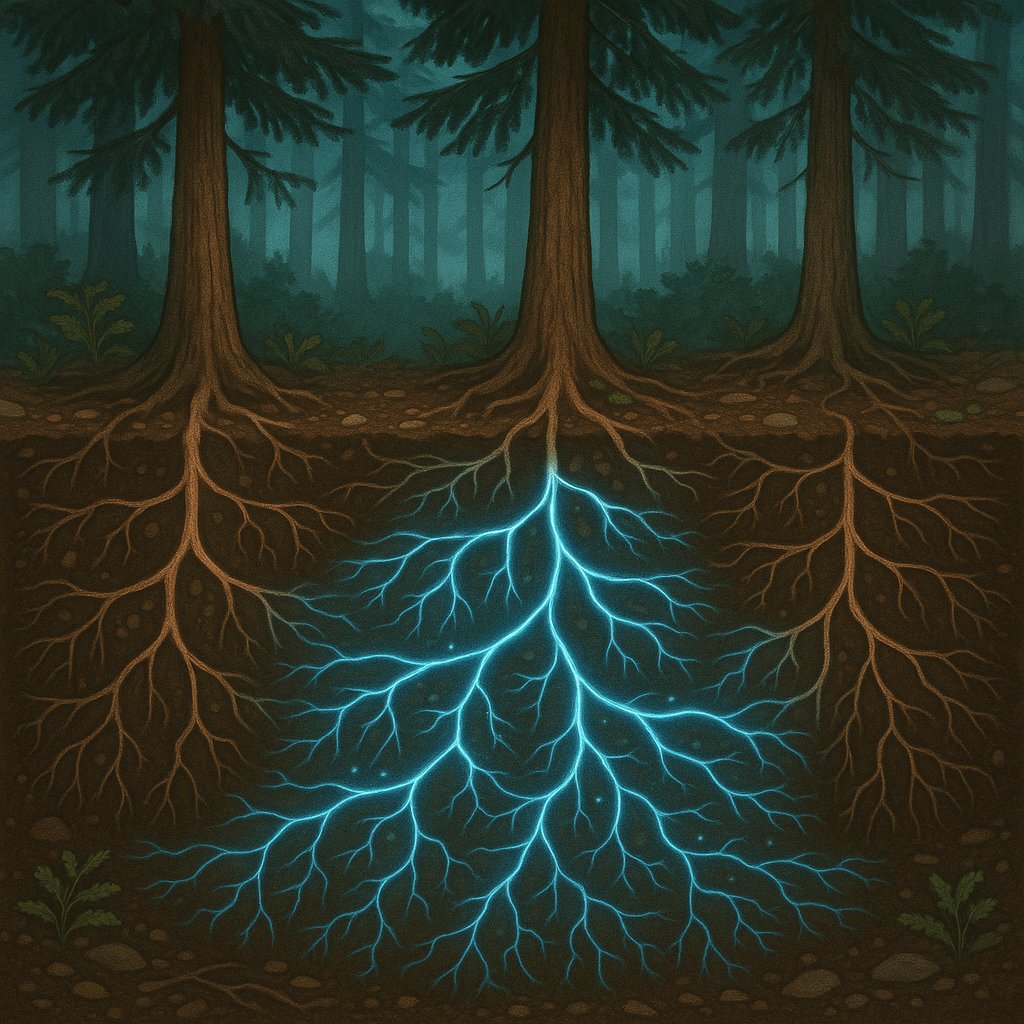
Here’s the part many articles skip: mycorrhizal networks connect multiple plants simultaneously. A mature Douglas fir in a Pacific Northwest forest can be linked to dozens of neighboring trees through shared fungal pathways. Research by ecologist Suzanne Simard at the University of British Columbia has shown that carbon, water, and even chemical warning signals travel between trees through these connections. Older “mother trees” appear to funnel resources to younger seedlings, particularly their own offspring.
This isn’t metaphor. It’s measurable nutrient transfer, tracked with isotopic labeling in controlled studies.
How roots defend themselves – and call for backup
Roots are not passive victims of soil pathogens. They mount sophisticated defenses that researchers are only beginning to understand.
When a pathogenic fungus attacks, roots can:
- Release antimicrobial compounds called phytoalexins directly into the surrounding soil
- Recruit beneficial bacteria by altering the chemical composition of their exudates – essentially sending out a distress signal
- Thicken cell walls at the point of infection to create physical barriers
- Communicate the threat to neighboring roots (their own and sometimes other plants’) through chemical and electrical signals
A fascinating 2018 study in Science found that when tomato plants were attacked by a soil-borne pathogen, the composition of their root exudates shifted dramatically – attracting Bacillus bacteria that produce antibiotics effective against the specific attacker. The plant wasn’t just defending itself. It was recruiting mercenaries.
Nitrogen fixation – a partnership worth billions
Legumes – beans, peas, clover, alfalfa – have struck perhaps the most valuable deal in agriculture. Their roots form nodules that house Rhizobium bacteria, which convert atmospheric nitrogen (N₂) into ammonia the plant can use. This single biological process contributes an estimated 40 to 60 million metric tons of nitrogen to agricultural soils worldwide each year, saving farmers billions of dollars in synthetic fertilizer costs.
But the relationship isn’t automatic. The chemical handshake between legume roots and rhizobia involves a precise exchange of molecular signals – flavonoids from the root, Nod factors from the bacteria – and if the signals don’t match, the partnership simply doesn’t form. Each legume species recognizes only specific rhizobial strains, like a lock and key.
What damages this underground ecosystem?
Most competing articles mention tillage and chemical inputs in passing, but the mechanisms deserve a closer look.
Excessive tillage physically shreds mycorrhizal networks. Those fungal hyphae are thinner than human hair, and a single pass with a rototiller can destroy months of fungal growth. The network rebuilds, but slowly – and annual tilling never lets it reach full maturity.
High-phosphorus fertilization paradoxically suppresses mycorrhizal colonization. When phosphorus is abundant and easily accessible, plants stop investing carbon in their fungal partners. The fungi decline, and with them goes the plant’s extended nutrient-gathering network and disease resistance. It’s a classic case of short-term gain creating long-term vulnerability.
Soil compaction from heavy machinery limits root exploration. Roots in compacted soil grow shallower, are more vulnerable to drought, and access a smaller volume of nutrients. Interestingly, even roots in non-compacted soil grow differently in clay versus sandy loam – not because clay is “bad” soil, but because oxygen diffusion rates and mechanical resistance differ, and roots adapt their architecture accordingly.
Monoculture reduces the diversity of root exudates entering the soil, which in turn reduces microbial diversity. A field that grows the same crop year after year develops a less varied, less resilient soil microbiome. Cover cropping and crop rotation – practices central to regenerative agriculture – work partly because they introduce diverse root chemistries into the soil, feeding a broader range of beneficial organisms.

What gardeners and growers can actually do
Understanding root biology isn’t just academic. It translates into practical choices that make a real difference, whether you’re managing a backyard garden bed or a 500-acre farm.
- Minimize soil disturbance. No-till or reduced-till practices preserve mycorrhizal networks and soil structure. If you must dig, do it selectively – transplanting holes rather than full-bed tilling.
- Feed the soil, not just the plant. Compost, mulch, and cover crops provide the carbon that root-associated microbes need to thrive. A diverse microbial community feeds roots more effectively than any single fertilizer.
- Plant diversity matters. Interplanting, polycultures, and diverse cover crop mixes create a richer rhizosphere. Each plant species attracts a slightly different microbial community, and together they build a more robust underground ecosystem.
- Water deeply and less often. Shallow, frequent watering encourages shallow root growth. Deeper, less frequent irrigation trains roots to explore lower soil horizons, making plants more drought-resilient.
- Stop fearing fungi. That white fuzz on your mulch? Probably beneficial saprophytic fungi breaking down organic matter. The mushrooms popping up in your garden beds? Often a sign of healthy soil biology, not disease.
Roots are rewriting what we know about plants
For centuries, we treated the soil as a static medium – just dirt that holds plants upright while fertilizer provides the food. That view is crumbling under the weight of evidence from soil science, molecular biology, and ecology. Roots are active participants in a living system of extraordinary complexity, making decisions, forming relationships, and shaping the very soil they inhabit.
Every time you step on earth, you’re walking over a network that took millions of years to evolve and can be damaged in a single afternoon with a plow. That’s worth pausing over.
If the hidden intelligence of plants fascinates you as much as it does me, keep exploring. The language of roots – chemical, electrical, fungal – is one of those subjects where every answer opens ten new questions. For more thought-provoking perspectives on topics that sit at the intersection of nature, language, and learning, Learn to Love Your Words offers a refreshing space to dig deeper into the ideas that shape how we understand our world.
Leave a Reply